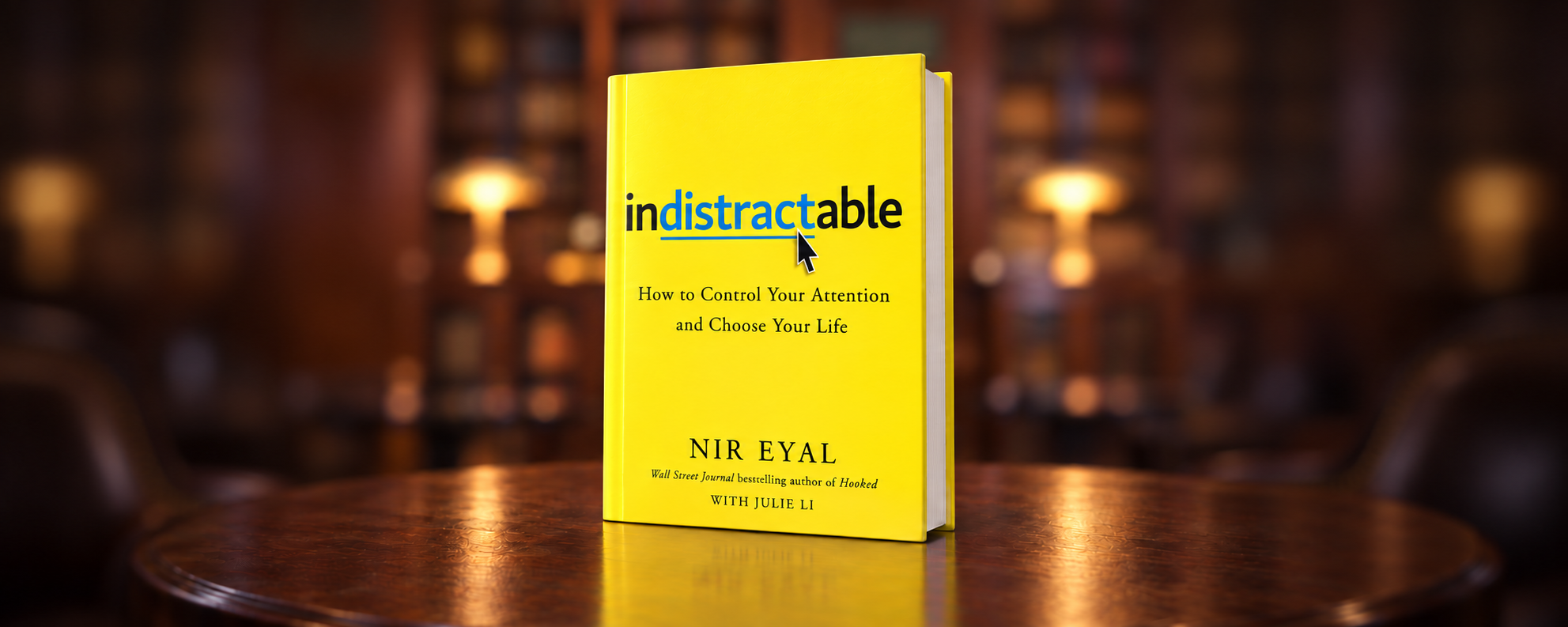
I recently read the book Indistractable by Nir Eyal. He's a consultant in Silicon Valley, he teaches tech companies how to build addictive apps, his first book was a big bestseller: Hooked: How to Build Habit-Forming Products.
Now in Indistractable, he's teaching us how to defend ourselves against the very tricks he helped popularize.
The main idea of the book is:
Stop blaming the apps & your phone, take responsibility.
First for that, we need to understand that the problem starts with us.
Specifically, what happens in the split second before you unlock your screen?
If you pay close attention, you'll realize you open it to relieve an internal urge.
It's a tiny spike of discomfort: like boredom, anxiety, fear. A subtle inner tension that demands release.
For example:
- I enter the elevator, it starts to go up → I have a spike of discomfort: I feel bored → I open YouTube to ease the pain.
- I enter my bed, going to sleep → I have a spike of anxiety, I'm afraid of being alone with my thoughts → I open Spotify and listen to a podcast to remove this anxiety.
- I'm on my laptop, working, the task in front of me is difficult → For a split second I feel discouragement, I feel I won't make it → I open Instagram to ease this pain.
- I am walking in the street, I think "what will the weather be tomorrow?" → I have a spike of anxiety about tomorrow's weather → I open the weather app to kill this anxiety.
These internal urges, or what the author calls "internal triggers", are the root cause of (all) our behavior.
The loop
After reading this book, I started paying close attention to these internal urges. I noticed that I wasn't just checking my phone due to anxiety - I was getting stuck on it because new urges kept popping up.
Let me give you an example of how this loop traps me:
- 10:20:01: It's been an hour since I checked my phone → A small anxiety spikes ("Maybe someone responded") → I open WhatsApp to check
- 10:20:02: I see no new messages → A feeling of disappointment → I automatically open YouTube to feel better
- 10:20:10: I see a video titled "AI is going to destroy us" → A new urge ("I need to know what that means") → I click the video to kill the anxiety
- 10:32:00: The video ends → A new spike of boredom → I click on the next recommendation to remove this boredom.
Result: it's been an hour and I'm watching YouTube videos…
This kind of scenario, where you indulge one internal urge only to get trapped by another, was happening constantly.
By becoming more aware of them, I was finally able to break the loop.
Your biology is working against you
The author explains several psychological biases that amplify these internal urges. Namely:
- Boredom: Our brains hate doing nothing. In a famous experiment, participants preferred to give themselves electric shocks rather than sit alone with their thoughts for 15 minutes. The good news? We can train our minds to handle boredom better.
- Negativity Bias: We are wired to focus on threats. If I launch a product and get 10 praises and 1 negative comment, my brain obsesses over the negative one. It's a survival mechanism to keep us safe, but it fuels anxiety.
- Rumination: Our tendency to replay past events on a loop. I used to obsess over text messages: "Did I send a clear enough message?". This generates anxiety, which triggers a new internal urge to check the phone again.
- Hedonic Adaptation: The "happiness treadmill." Our brains quickly adapt to new pleasures. Checking your phone 30 times a day becomes your "new normal." The relief fades, so you check even more just to feel okay.
Closing thoughts
Becoming aware of my internal urges has reduced my phone usage.
The book also offers practical strategies similar to other self-help books:
- changing your identity and self-talk ("I am indistractable")
- defining your values and goals to schedule time for them in advance (time-blocking)
- carefully designing your environment to minimize distractions (put your phone in another room).
I implemented these strategies as well, and they definitely helped me stay focused, achieve more, and feel more fulfilled.